
The magpie is a thief!

That’s the whole point of the metaphor. It takes what catches its eye from wherever it finds it… a bit of wire, a scrap of foil, something shiny someone else dropped and builds something new with the pieces.
But there’s a craft to stealing well. Grab everything indiscriminately and you end up with a pile of junk instead of a nest. Steal nothing and you’re starting from scratch every time, ignoring the accumulated work of everyone who figured something out before you.
In Steal What Works, Leave the Rest, I laid out the philosophy. This is the operational version: how to actually evaluate what’s worth stealing and what to leave behind.
The Problem with Productivity Advice
Most productivity systems come packaged as complete answers. GTD says: here is how you process everything. PARA says: here is how you organize everything. Zettelkasten says: here is how you connect everything. Atomic Habits says: here is how you build everything.
These are good systems. They’re built by smart people who thought deeply about how they work. They’re also designed for a hypothetical person whose life and workflow resemble the author’s. That person is probably not you.
The impulse to adopt a system wholesale is understandable, it’s much easier than doing the work of evaluating each piece. But wholesale adoption means you get the parts that fit your life and the parts that don’t, welded together in a package you feel obligated to maintain completely.
The alternative is selective theft. Take the parts that solve a real problem in your actual workflow and leave the rest.
What Makes Something Worth Stealing
A piece of a system is worth stealing if it meets three criteria:
It solves a problem you actually have. Not a problem the author had, not a problem you might have someday, a problem you’re experiencing right now. If you don’t have a capture problem, you don’t need GTD’s inbox processing ritual. If you’re not managing multiple active projects, you don’t need PARA’s full folder structure.
It’s smaller than the system it came from. The best steals are atomic. Not “I’m adopting GTD” but “I’m adopting the two-minute rule.” Not “I’m going full PARA” but “I’m going to keep a Projects folder and an Archive folder.” Atomic steals integrate without forcing you to adopt the surrounding context.
You can evaluate it within two weeks. If a habit, tool, or practice doesn’t show a measurable result in two weeks, you’re either implementing it wrong or it doesn’t fit your workflow. Good steals produce feedback quickly. Systems that require months of faithful implementation before you can evaluate them are selling you faith, not method.
What to Leave Behind
The flip side is knowing what not to take.
Don’t steal what requires context you don’t have. Zettelkasten works beautifully for researchers and writers who are building arguments across hundreds of linked notes. If you’re a project manager who needs to track deliverables, the Zettelkasten linking workflow will feel like overhead without payoff. That’s not a failure of Zettelkasten. It’s a mismatch.
Don’t steal what solves someone else’s problem. The person who built a complex inbox zero ritual was drowning in email. If email isn’t your pain point, their ritual isn’t your solution, no matter how elegant it is.
Don’t steal what you admire but won’t use. There’s a category of productivity practice that I find intellectually interesting and would never actually do. A daily full review of all projects and commitments. Color-coded task labels. Manual time logging. I’ve tried all of these and abandoned all of them. I still think they’re good ideas. They’re just not my ideas.
The Actual Practice
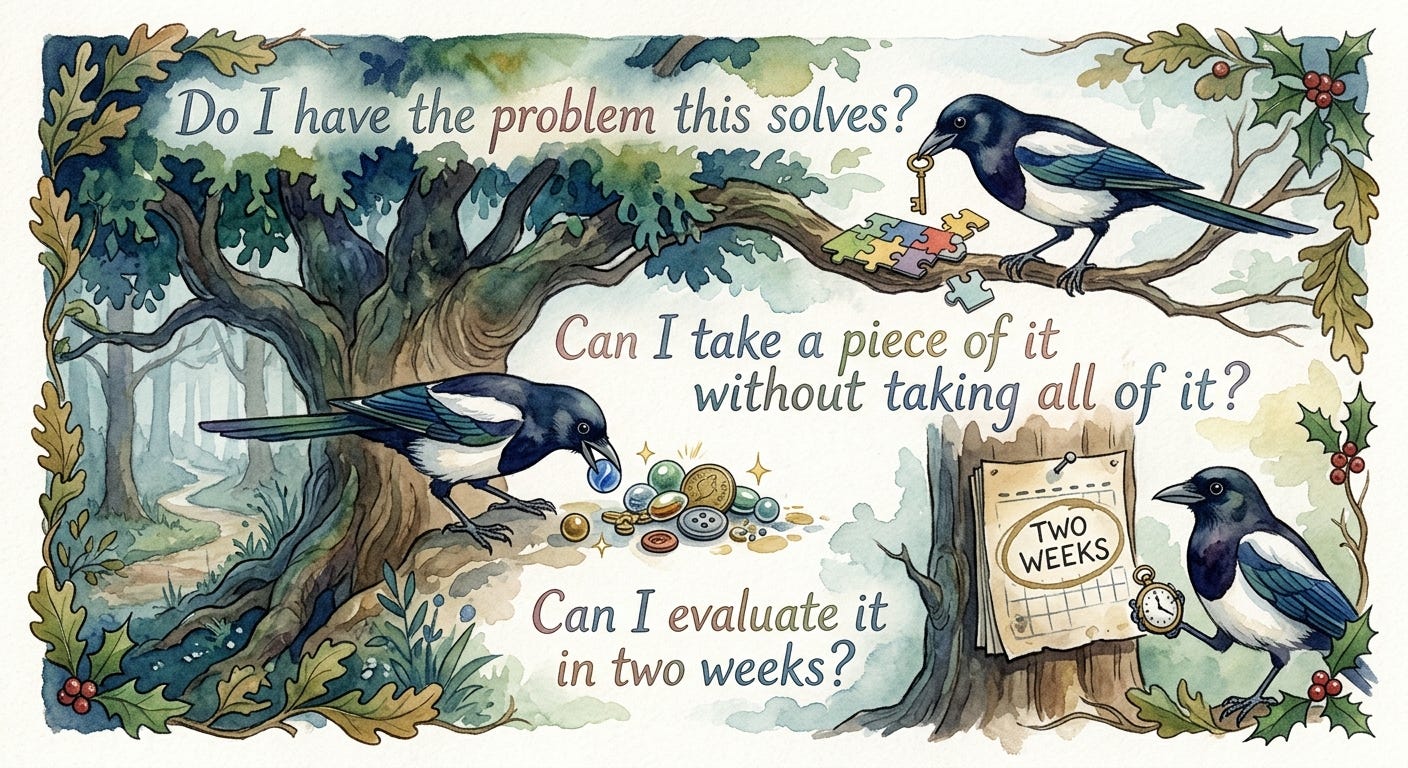
When you encounter a system, tool, or practice that interests you, run it through the three-question filter before adopting it:
Do I have the problem this solves?
Can I take a piece of it without taking all of it?
Can I evaluate it in two weeks?
If yes to all three: steal it. Try the piece. Evaluate honestly. Keep or discard.
If no to any of them: appreciate it from a distance and move on.
The nest you’re building is yours. It should look like your life, not someone else’s framework installed wholesale and maintained out of obligation.