
Most productivity advice is written for people who already have time.
That sounds obvious, but it explains why so much of it falls apart the second real life shows up. The advice assumes you can sit down for a weekly review with coffee and a clear desk. It assumes you have an hour to rebuild your task manager. It assumes your problem is that you have not found the right framework yet.
Sometimes the real problem is that you have eleven minutes before the next thing, your brain is tired, and every task on your list looks bigger than the amount of energy you have left.
That is the situation the 5-Minute Task System is built for.
The Trap of the Big System
I love productivity systems. I wrote about my larger setup in Building a Magpie’s Nest: My Scavenged Productivity System, but this is the smaller emergency tool inside that bigger approach. I would not have started The Productive Magpie if I did not enjoy picking through tools, templates, apps, workflows, automations, and weird little methods that make life run better.
But there is a trap in all of it.The bigger the system gets, the harder it is to use when you are already behind. When your task manager has twelve areas, four priority levels, custom filters, nested projects, contexts, tags, energy states, someday lists, and recurring reviews, it can be wonderful on a calm day. It can also become one more room you have to clean before you are allowed to do the work.
That is backwards.
A productivity system should help when your day is messy. If it only works when your life is quiet, it is not a system. It is decor. The 5-Minute Task System starts from a different assumption: you are busy, interrupted, and probably carrying more open loops than you can comfortably name. So instead of asking, “What is the perfect way to organize everything?” It asks, “What can I move forward in five minutes?”
Why Five Minutes Works
Five minutes is too short to intimidate you.
It is also long enough to matter.
You can answer the text.
You can put the receipt where it belongs.
You can unload part of the dishwasher.
You can write the ugly first paragraph.
You can open the document and leave yourself the next sentence.
You can schedule the appointment.
You can pay the bill.
You can rename the file.
You can send the follow-up.
None of those feel like a dramatic productivity breakthrough. That is the point.
I had to call about my medications to answer questions as required by my insurance. I had been putting this off all day because it meant talking on the phone with another human being. As I was leaving the studio, I just decided I was going to get it done, so I pulled out my phone and was finished with the call by the time I got to my truck. Something that had been bothering me all day was completed in under 50 steps.
Most of the pressure in a busy life does not come from one giant task. It comes from the pileup of tiny unresolved things that keep asking for attention in the background.
The unanswered message.
The thing you need to return.
The form you need to fill out.
The appointment you need to make.
The note you need to capture before you forget why it mattered.
Each one is small enough to dismiss. Together, they turn into static. The 5-Minute Task System is a way to lower the static.
The System
Here is the basic version. Make a list of tasks that can be moved forward in five minutes or less. Not completed necessarily. Moved forward. That distinction matters.
“Clean the garage” is not a 5-minute task. “Throw away the cardboard by the garage door” is.
“Write the newsletter” is not a 5-minute task. “Write three possible openings” is.
“Get my finances together” is not a 5-minute task. “Download the bank statement” is.
The move is to break tasks down until the next action is so small that your brain stops arguing with it. Then, when you have a weird gap in the day, you do one.
Waiting on coffee? Do one.
Five minutes before a meeting? Do one.
Sitting in the car before walking inside? Do one.
Your energy is low and you cannot face the big thing? Do one.
The Magpie Version
The Magpie Method is not about pledging loyalty to one productivity religion. It is about stealing what works and leaving the rest.
This system steals from a few places:
Getting Things Done gives us the next action.
Atomic Habits gives us the idea that small actions compound.
Bullet Journaling gives us permission to keep the list simple.
Plain old survival gives us the truth that busy people need systems that work in bad conditions.
I wrote more about that identity side in The Identity of a Productive Magpie, but this system is the ground-level version: one small action, then another. I do not care whether the list lives in Obsidian, Apple Notes, Todoist, TickTick, Notion, a sticky note, or the back of an envelope. Use whatever you will actually open.
What Goes on the List
A good 5-minute task should be specific enough that you know exactly what to do when you see it.
Bad:
Work on taxes
Clean kitchen
Fix website
Plan content
Better:
Find W-2 and put it in tax folder
Clear the left side of the counter
Check if the homepage button works
List five newsletter headlines
The test is simple: if you read the task while tired and still understand the next move, it belongs on the list.
If you have to think, rewrite it.
What Does Not Go on the List
Do not put fake 5-minute tasks on the list. You know the kind.
“Outline entire course.”
“Organize all photos.”
“Fix my life.”
Or one that I find myself using often, “Admin tasks.”
Those are not tasks. The system only works if you are honest about size. Five minutes means five minutes. Maybe seven if you are already moving. If it turns into forty-five minutes, it was not a 5-minute task. Break it smaller and tackle the smaller parts so they add up.
Why This Helps Busy People
Busy people do not always need more ambition. They need fewer stalled objects in the path.
When you are juggling work, family, side projects, appointments, errands, health stuff, house stuff, and the strange administrative fog of modern life, your brain gets tired of holding all the tiny things.
The 5-Minute Task System gives those things somewhere to go. More importantly, it gives you a way back in. That might be the most useful part. When you fall off your system, you do not need a grand reset. You do not need to spend Saturday rebuilding your Notion dashboard. You do not need to declare a new era. You need one small task you can finish. Then another... Then another. Momentum usually returns after movement, not before it.
A Simple Starter List
If you want to try this today, start with ten.
Reply to one message
Put one loose paper where it belongs
Clear one surface
Start one load of laundry
Write one bad paragraph
Rename one file
Schedule one appointment
Pay one bill
Capture one idea
Delete or archive ten emails
Do not make this precious. Do not build the perfect template first. Do not go app shopping. Write ten small tasks and do one of them. This is the same reason I love tiny systems like my Q shortcut. Small bits of saved friction add up.
The Product
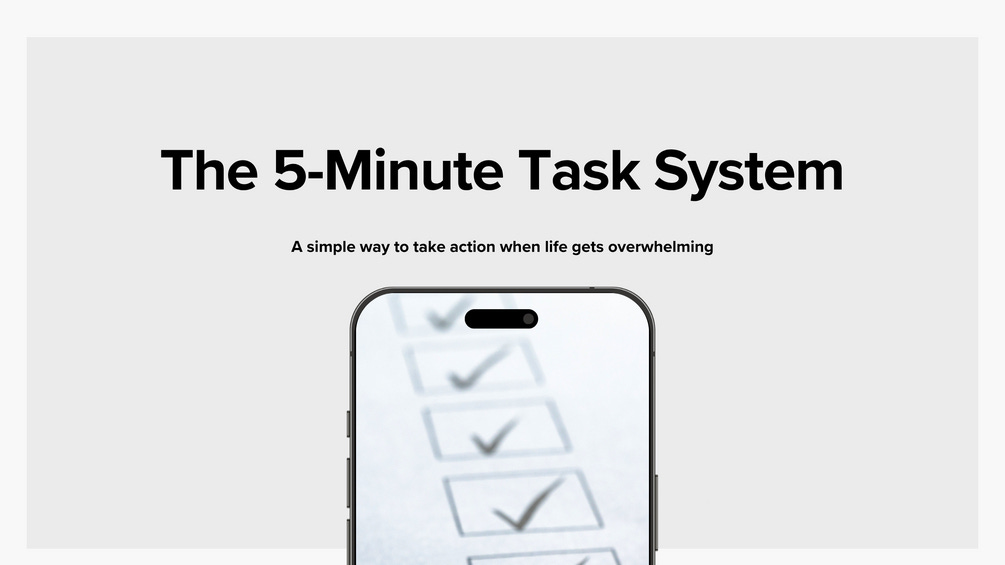
I turned this into a small product because I wanted the system to be easier to start than to overthink.
The 5-Minute Task System for Busy People gives you a ready-made structure for capturing tiny tasks, breaking down bigger ones, and keeping a short list of actions you can use when the day gives you a spare pocket of time.
It is not a life operating system.
It is a pressure valve.
You can grab it here:
If you are already behind, do not start by rebuilding everything.
Start with five minutes.
Disclosure: This article includes an affiliate link. If you sign up through it, I may earn a commission at no extra cost to you.
If the button above does not work click here: The 5-Minute Task System for Busy People